
This post is a bit for me, actually. This city immerses you in art, and I’m always curious to learn more. So I did a little research project to highlight some of the main influential artists who were touched by Barcelona. Then I realized it might be a good read for friends and family visiting us, so I’m sharing it here…

The Artists, Architects, and Writers Who Made Barcelona Iconic
Barcelona’s creative spirit has inspired architects, painters, and writers since Roman times, but we’ll focus on the last century or so, from Modernisme to the present. This guide highlights notable figures—past and present—who were either from Barcelona or spent significant time shaping its artistic and cultural identity.
Architects
Modernisme Era (Late 19th – Early 20th Century)
Antoni Gaudí (1852–1926) – Catalan architect and the leading figure of Modernisme. Gaudí spent most of his life in Barcelona, where he designed its most iconic landmarks, including the Sagrada Família, Park Güell, Casa Batlló, and Casa Milà (La Pedrera). His organic, nature-inspired style defines the city’s skyline.
https://en.wikipedia.org/wiki/Sagrada_Fam%C3%ADlia
Lluís Domènech i Montaner (1850–1923) – Born in Barcelona, Domènech designed ornate landmarks such as the Palau de la Música Catalana and Hospital de Sant Pau, both UNESCO World Heritage Sites. His work blended structural innovation with rich decoration.
https://en.wikipedia.org/wiki/Palau_de_la_M%C3%BAsica_Catalana
Josep Puig i Cadafalch (1867–1956) – Another Modernisme master, Puig designed Casa Amatller, Casa de les Punxes, and Casa Martí (home to the famed Quatre Gats café). His mix of neo-Gothic and Catalan modernist elements helped define Barcelona’s architectural charm.
https://en.wikipedia.org/wiki/Casa_Amatller
Late 20th – 21st Century (Contemporary Architecture)
Ricardo Bofill (1939–2022) – Born in Barcelona, Bofill founded the Taller de Arquitectura and became a global name for bold postmodern designs. His Walden 7 apartment complex near Barcelona and work on El Prat Airport showcase his signature monumental style.
https://en.wikipedia.org/wiki/Walden_7
Enric Miralles (1955–2000) – A Barcelona native known for his imaginative, organic designs. He co-designed the Santa Caterina Market renovation and created the acclaimed Scottish Parliament Building. His projects continue to influence contemporary architecture worldwide.
https://en.wikipedia.org/wiki/Santa_Caterina_market
Painters & Sculptors
Modernisme and Avant-garde (Late 19th – Early 20th Century)
Santiago Rusiñol (1861–1931) – Painter, writer, and one of Catalonia’s great Modernistes. A Barcelona native, he helped establish the city’s bohemian scene at Els Quatre Gats, inspiring younger artists like Picasso.
https://en.wikipedia.org/wiki/Santiago_Rusi%C3%B1ol
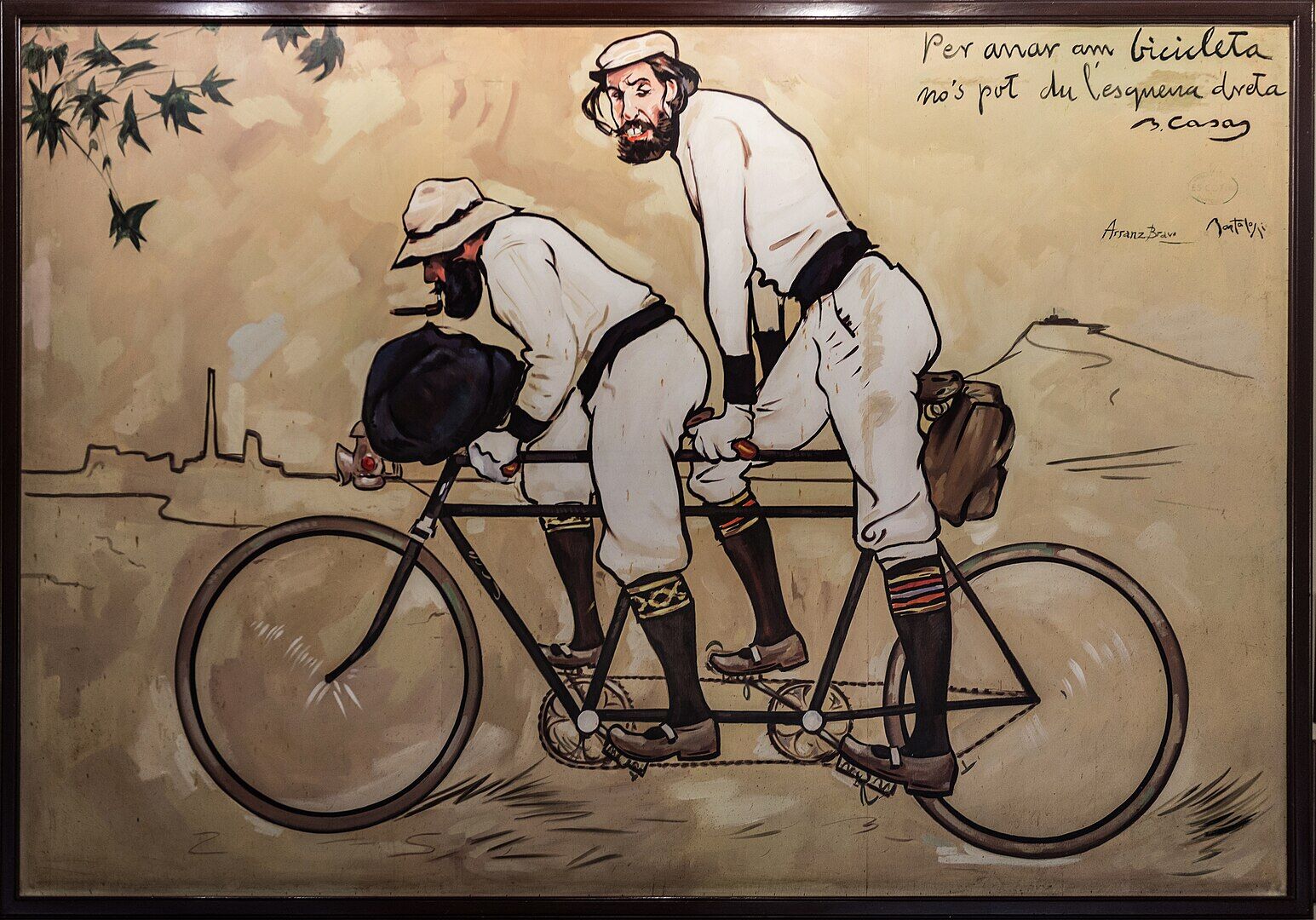
Ramon Casas (1866–1932) – Barcelona-born painter known for elegant portraits and posters capturing the city’s turn-of-the-century life. His work helped define the visual identity of Modernisme.
https://en.wikipedia.org/wiki/Ramon_Casas
Pablo Picasso (1881–1973) – Though born in Málaga, Picasso grew up and trained in Barcelona, calling it his true home. His early years at the Els Quatre Gats café shaped his career. The Museu Picasso now houses one of the world’s most comprehensive collections of his early works.
https://en.wikipedia.org/wiki/Museu_Picasso_(Barcelona)
Mid 20th Century (Surrealism and Abstract Art)
Joan Miró (1893–1983) – Born in Barcelona, Miró developed a playful, dreamlike abstract style that influenced generations. His Fundació Joan Miró museum and the public sculpture Dona i Ocell are must-sees for art lovers.
https://en.wikipedia.org/wiki/Fundaci%C3%B3_Joan_Mir%C3%B3
Salvador Dalí (1904–1989) – The Surrealist icon from Figueres, just north of Barcelona, often exhibited in the city and influenced its avant-garde scene. His eccentric works and persona remain a key part of Catalan art heritage.
https://en.wikipedia.org/wiki/Salvador_Dal%C3%AD
Antoni Tàpies (1923–2012) – A Barcelona-born abstract artist, Tàpies pioneered Spain’s postwar avant-garde movement. His textured, material-based paintings redefined modern Spanish art. Visit the Fundació Antoni Tàpies to explore his work.
https://en.wikipedia.org/wiki/Fundaci%C3%B3_Antoni_T%C3%A0pies
Contemporary Artists
Jaume Plensa (1955– ) – Internationally acclaimed sculptor from Barcelona known for his monumental public art installations. Works like Carmela (near the Palau de la Música) and the Crown Fountain in Chicago reflect his poetic minimalism.
https://en.wikipedia.org/wiki/Jaume_Plensa
Writers & Poets
Catalan Renaixença and Modernisme (19th – Early 20th Century)
Jacint Verdaguer (1845–1902) – Poet-priest known as the father of modern Catalan literature. His epic Canigó and poem A Barcelona celebrated the Catalan spirit and the city’s transformation.
https://en.wikipedia.org/wiki/Jacint_Verdaguer
Joan Maragall (1860–1911) – Barcelona poet and essayist whose works bridged Romanticism and Modernisme. His home is now the Casa Museu Joan Maragall, preserving his literary legacy.
https://en.wikipedia.org/wiki/Joan_Maragall
Civil War and Postwar Literature (1930s–1960s)
George Orwell (1903–1950) – The English author spent several months in Barcelona during the Spanish Civil War. His book Homage to Catalonia vividly recounts the revolutionary energy and chaos of the 1937 May Days. Orwell’s experience in Barcelona shaped his later anti-totalitarian works.
https://en.wikipedia.org/wiki/Homage_to_Catalonia
Ernest Hemingway (1899–1961) – While not a resident, Hemingway covered the Spanish Civil War from Catalonia, including brief stays in Barcelona between 1937–1938 as a war correspondent. His dispatches described the city’s wartime atmosphere and the refugees fleeing along Catalonia’s roads—a lesser-known but vivid part of his Spanish chronicles.
https://en.wikipedia.org/wiki/Ernest_Hemingway
Mercè Rodoreda (1908–1983) – Barcelona-born novelist best known for La Plaça del Diamant (The Time of the Doves), a powerful story set in the Gràcia neighborhood during the Civil War and its aftermath.
https://en.wikipedia.org/wiki/Merc%C3%A8_Rodoreda
Carmen Laforet (1921–2004) – Born in Barcelona, Laforet’s Nada captured postwar Barcelona’s gloom and earned her Spain’s first Nadal Prize.
https://en.wikipedia.org/wiki/Carmen_Laforet
Contemporary (Late 20th – 21st Century)
Manuel Vázquez Montalbán (1939–2003) – Barcelona native and creator of the detective Pepe Carvalho, whose novels double as culinary and social tours of the city.
https://en.wikipedia.org/wiki/Manuel_V%C3%A1zquez_Montalb%C3%A1n
Gabriel García Márquez (1927–2014) – The Colombian Nobel laureate lived in Barcelona (1967–1975) during the Latin American literary Boom, writing The Autumn of the Patriarch and befriending major authors.
https://en.wikipedia.org/wiki/Gabriel_Garc%C3%ADa_M%C3%A1rquez
Carlos Ruiz Zafón (1964–2020) – Barcelona-born author of The Shadow of the Wind, which immortalized the city’s Gothic Quarter in global literature.
https://en.wikipedia.org/wiki/Carlos_Ruiz_Zaf%C3%B3n
Ildefonso Falcones (1959– ) – Author of Cathedral of the Sea, set around the building of Santa Maria del Mar in 14th-century Barcelona. His historical novels capture the city’s medieval past in vivid detail.
https://en.wikipedia.org/wiki/Ildefonso_Falcones
Looking Further Back
While Barcelona’s best-known artists came from the Modernisme and modern art movements, the city’s creative story began long before Gaudí and Miró. Centuries earlier, Greek settlers at Empúries (around 575 BC) brought Mediterranean notions of balance, form, and ornamentation to Catalonia’s shores—ideas that would ripple through Roman mosaics, Gothic altarpieces, and eventually the sinuous lines of Modernisme itself. From ancient craftsmen to medieval painters, Barcelona’s artistic DNA runs deep. For travelers who love art history, this is where the story begins: from the ruins of Barcino to the frescoed chapels of the Gothic era.
https://en.wikipedia.org/wiki/Emp%C3%BAries
Roman & Early Christian Foundations
Barcelona began as the Roman colony Barcino (1st century BC), parts of which still stand within the Gothic Quarter. Visitors can explore remnants of ancient walls and streets beneath the Museu d’Història de Barcelona (MUHBA), which preserves mosaics, wine presses, and bathhouses from the Roman city.
https://en.wikipedia.org/wiki/Roman_walls_of_Barcelona
Romanesque & Early Medieval (11th–13th Centuries)
The Catalan Pyrenees produced some of Europe’s most remarkable Romanesque mural art, much of which is now housed in Barcelona’s Museu Nacional d’Art de Catalunya (MNAC).
Master of Taüll (c. 12th century) – An anonymous painter known for the frescoes of Sant Climent de Taüll, featuring the iconic “Christ in Majesty,” now displayed in MNAC’s Romanesque galleries.
https://en.wikipedia.org/wiki/Master_of_Ta%C3%BCll
The MNAC’s Romanesque collection showcases the artistry of early Catalan painters and craftsmen.
https://www.museunacional.cat/en/collections/medieval-romanesque-art
Gothic & Late Medieval (14th–15th Centuries)
By the Gothic period, Barcelona had become a thriving Mediterranean hub, commissioning grand altarpieces and illuminated manuscripts.
Ferrer Bassa (active c. 1320–1348) – Court painter who introduced Italian influence to Catalan Gothic art.
https://en.wikipedia.org/wiki/Ferrer_Bassa
Arnau Bassa (14th century) – Son of Ferrer, known for refined devotional panels blending Gothic grace with naturalism.
https://en.wikipedia.org/wiki/Arnau_Bassa
Lluís Borrassà (c. 1360–c. 1426) – Barcelona workshop master who popularized the International Gothic style through large-scale altarpieces.
https://en.wikipedia.org/wiki/Llu%C3%ADs_Borrass%C3%A0
Bernat Martorell (d. 1452) – A leading late-Gothic painter whose works, like the Saint George Altarpiece, exemplify Catalonia’s medieval splendor.
https://en.wikipedia.org/wiki/Bernat_Martorell
Where to See It
Museu Nacional d’Art de Catalunya (MNAC) – Houses the world’s largest collection of Catalan Romanesque and Gothic paintings.
https://www.museunacional.cat/en
MUHBA (Museu d’Història de Barcelona) – Offers an underground journey through Roman Barcino.
https://museuhistoria.bcn.cat/en
A Tip for Visitors
From Gaudí’s fantastical facades to Miró’s surreal sculptures and Zafón’s literary shadows, Barcelona itself is a living gallery. Wander its streets, visit the artists’ foundations, and you’ll find that every corner holds a piece of art history waiting to be rediscovered.